
Good morning, friends of simplyroads.com. I’m here in France as a guest of ADICHAT, and it’s proving to be a very inspiring experience.
This morning my ride starts from the castle of Villandraut.
While I adjust my helmet, let me tell you about this 14th-century palace-fortress commissioned by Pope Clement V. Bertrand de Goth was born in Villandraut in 1264 and, after being elected pope in 1305, ordered the construction of this fortified manor, even paving the moat as a demonstration of his wealth. Its massive towers and high ramparts were privileged witnesses to the turbulent historical period of the wealthy Aquitaine region—from the suppression of the Templars to the English crown’s struggle for these lands during the Hundred Years’ War.
The sky over Villandraut today has a soft, flat light. The Landes de Gascogne give me perfect moments for these tours on my new European stage in Nouvelle Aquitaine.
I leave the village and take the fast cycle path towards Saint-Symphorien until I turn off for La Ferrière, perhaps once a place where iron was worked long ago. I’ve been riding for barely half an hour, yet here you can already take a first break near a small pond.
I get going again and, after a short paved section, I find another sandy stretch—typical of many of the trails in the area. The pace is good; the tires sink just enough to remind me that the terrain composition changes often: you need to adapt, read the forest, the greenery around you, quickly understand what’s coming your way and where you can place your wheels.
These days I’m exploring new trails that will allow me to create bike routes suitable for everyone: MTB or gravel enthusiasts, experienced cycle tourists, or even families out for a Sunday ride.
It’s in moments like these that I can draw on my experience as an MTB guide on the Asiago Plateau and the expertise gained in the ERASMUS+ Bicycle project in Sarón, Cantabria, Spain. There, I helped design trails that respect the environment and are useful to the people who live in the area every day. I bring the same mindset here: every trail is a service, an opportunity—a way to help people discover and experience nature sustainably and to appreciate local history and culture.
After circling around the area of La Ferrière, I head quickly toward Balizac and leave the road again near an oasis with a picnic area—perfect for another short break. Then I drop onto more compact, tight, and twisting singletrack along the Ciron River.
This is the kind of terrain I love: you have to focus on the trail, stay sharp, and tune in only to what surrounds you—joy and pure fun.
In the Landes, if you listen and stay silent with your breath, you’re never truly alone.
In fact, around a bend along the Ciron, something rustles in the bushes. I only hear the noise—until suddenly a fox darts across the path. Just a few seconds, maybe it didn’t even notice me, but my heart is racing now.
It’s one of the wonderful things that happens when you ride while respecting the nature around you.
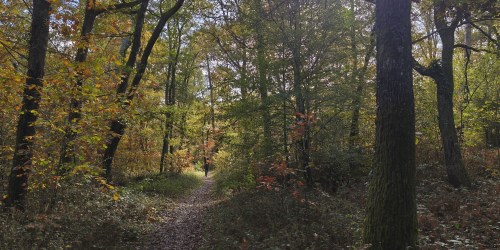
Exiting near Villandraut, I continue south into the Bois de Luc, still following the Gorges du Ciron. Here the trail widens and enters a lush forest with a humid microclimate, crossed by the traces of wild animals. All around, the tree branches and the song of a few birds create a soft, slightly melancholic melody—much like autumn. The forest seems to tell its story step by step.
Now I ride along a small lake that looks like a bird sanctuary—I’ll have to look into that. The stretch is muddy, another typical feature of these forests: when it rains, everything changes. The trail becomes technical, slippery, fun; every root comes alive. But that’s exactly what I love: you never ride the same loop twice. Every place feels alive. The ground shifts like desert dunes.
Reaching La Trave Est (D222), I discovered another fortress built in 1310 by the same engineer who designed Villandraut, Arnaud-Bernard de Preyssac. This one was commissioned by Clement V for his nephew. Unfortunately, only partially buried ruins remain, but they are still fascinating.
A short break in the castle courtyard: I try to imagine what life might have been like back then—surely plague must have reached here too, along with war.
I set off again heading north, roughly following the left bank of the Ciron.
I ride between pines, resting fields, and country houses. I let my thoughts wander—to why I chose the Villandraut project in the first place.
The reason is simple: it’s a territory with enormous potential for cycle tourism, where so much is still waiting to be highlighted. From the forests of the Parc Naturel Régional des Landes de Gascogne to the open areas toward Bazas and Langon—every kilometer seems to ask to be explored, studied, mapped.
And thanks to ADICHAT, and to the precious help of Robin and Billie, this project will take shape and continue to grow in the future.
During the final stretch, as my bike rolls again over a mix of sand and pine needles near the lakes of Hostens, the mantra I brought back from Spain returns to mind:
cycle tourism can change communities, it can bring people together, it can help rediscover a more authentic way of experiencing nature.
Here in Villandraut I’m not riding just for myself—I’m riding to build something that will last.
Something that future riders will cross, feeling beneath their wheels the history of a land that wants to be discovered.

italian version
Buongiorno amici di simplyroads.com, sono qui in Francia ospite di ADICHAT ed è un’esperienza molto stimolante.
Questa mattina il mio giro parte dal castello di Villandraut.
Mentre mi regolo il casco, vi racconto di questo palazzo-fortezza del XIV secolo voluto da papa Clemente V. Bertrand de Goth nacque a Villandraut nel 1264 e diede ordine, dopo la sua elezione a papa nel 1305, di edificare il maniero fortificato del quale fece lastricare anche il fossato come prova della sua ricchezza. Le sue imponenti torri e i suoi alti bastioni furono testimoni privilegiati del turbolento periodo storico della ricca Aquitania che va dalla soppressione dei Templari alla contesa di quei territori da parte della corona inglese durante la guerra dei cent’anni.
Il cielo sopra Villandraut oggi ha una luce piatta, morbida. Le Landes de Guascogne regalano momenti perfetti per questi miei tour nella nuova tappa europea nella Nouvelle Aquitaine.
Lascio l’abitato e imbocco la veloce pista ciclabile in direzione di Saint Symphorien fino a prendere la deviazione per La Ferrière, forse un tempo lontano sede di lavorazione del ferro. Sono fuori da poco meno di mezz’ora, ma qui si può già fare una prima sosta nei pressi di un piccolo stagno.
Riprendo il giro e, abbandonato un breve segmento d’asfalto, trovo nuovamente un bel tratto sabbioso, caratteristica di gran parte dei sentieri della zona. La velocità è buona, le gomme affondano quel tanto che basta per ricordarmi che qui la composizione del terreno cambia spesso: occorre adattarsi, leggere il bosco, il verde intorno, capire velocemente cosa ti viene incontro e dove poter mettere le ruote.
In questi giorni sto valutando sentieri sempre nuovi che mi permettano di creare percorsi ciclabili adatti a tutti: appassionati di MTB o gravel, ma anche per cicloturisti esperti o per gite domenicali.
È proprio in questi momenti che posso mettere a frutto la mia esperienza di guida MTB dell’Altopiano di Asiago e l’esperienza maturata nel progetto ERASMUS+ Bicycle in Spagna, a Saron in Cantabria. Lì ho partecipato alla progettazione di percorsi che rispettino l’ambiente e che siano utili anche a chi vive il territorio quotidianamente. Qui porto la stessa mentalità: ogni sentiero è un servizio, un’opportunità.
Dopo aver fatto un giringiro nei dintorni di La Ferrière mi dirigo spedito verso Balizac, abbandono di nuovo la strada nei pressi di un’oasi con area picnic, ottima per un’altra piccola pausa. Mi getto su single track più compatti, stretti e sinuosi lungo il fiume Ciron.
È il terreno che preferisco: devi puntare il focus sul sentiero, restare concentrato, puoi solo ascoltare ciò che ti sta attorno, divertimento e gioia.
Nelle Landes, se ascolti e stai in silenzio con il tuo respiro, non sei mai davvero solo.
Infatti, in una curva del Ciron qualcosa si muove fra i cespugli, ne sento solo il rumore. Ma ecco, all’improvviso mi attraversa il sentiero una volpe. Pochi secondi, forse non si è neppure accorta di me, ma il mio cuore batte più veloce ora.
È una delle cose meravigliose che ti succedono se pedali rispettando la natura che ti circonda.
Uscito nei pressi di Villandraut proseguo verso sud imboccando le Bois de Luc, sempre lungo le Gorges du Ciron. Qui il sentiero è largo e si addentra in un bosco lussureggiante e dal microclima umido, ed è attraversato da tracce di animali selvatici. Tutto attorno le fronde degli alberi e il canto di alcuni uccelli compongono una melodia tenue, un po’ triste come l’autunno… il bosco sembra raccontare la sua storia passo dopo passo.
Ora costeggio una laghetto, sembra un’oasi ornitologica -dovrò approfondire-, il tratto è fangoso. Altra caratteristica di queste foreste: se piove, cambia tutto. Il percorso diventa tecnico, viscido, divertente, ogni radice prende vita propria. Ma è anche questo che amo: qui non fai mai due giri identici. Ogni luogo è vivo. Il terreno sembra mutare come le dune del deserto.
Raggiunta La Trave Est (D222), ho scoperto un’altra fortezza edificata nel 1310 sempre dallo stesso ingegnere di quella di Villandraut, Arnaud-Bernard de Preyssac. Questa fu fatta costruire da Clemente V per suo nipote. Purtroppo restano solo delle rovine in parte sepolte, tuttavia affascinanti.
Breve pausa nella corte del castello: provo ad immaginare come fosse e come si vivesse in quei tempi, anche qui sarà arrivata la peste oltre alla guerra.
Riparto verso nord, seguendo più o meno la sinistra orografica del Ciron.
Pedalo tra pini, campi oramai a riposo e case di campagna. Mi lascio andare ai miei pensieri e al perché ho scelto proprio il progetto di Villandraut.
Il motivo è semplice: è un territorio con un potenziale enorme per il cicloturismo, dove c’è ancora molto da valorizzare. Dai boschi del Parc Naturel Régional des Landes de Gascogne alle zone aperte verso Bazas e Langon. Ogni chilometro sembra chiedere di essere esplorato, studiato, mappato.
Ed è grazie ad ADICHAT, e al prezioso aiuto di Robin e Billie, che questo progetto prenderà forma e si svilupperà sempre più nel futuro.
Durante l’ultimo tratto, mentre la bici solca di nuovo un misto di sabbia e aghi di pino vicino ai laghi di Hostens, mi è tornato in mente il mantra che ho portato con me dalla Spagna:
il cicloturismo può cambiare le comunità, può unire, può far riscoprire un modo più autentico di vivere la natura.
Qui a Villandraut non pedalo solo per me, pedalo soprattutto per costruire qualcosa che resti.
Qualcosa che un domani altri bikers, magari proprio voi amici di simplyroads.com, attraverseranno, sentendo sotto le ruote la storia di un territorio che vuole essere scoperto.
 Akira06 Bike AdvenTour
Lascia un commento