
Bonjour à tous les amis de simplyroads.com!
Today, I will take you on a tour of the castles on the left bank of the Garonne. Our starting point and destination is once again the papal castle of Villandraut.
It is not the perfect day for cycling: the temperature is rather low and there is fog. But I have my 4KAAD glasses with yellow photochromic lenses for the fog, and I have always liked the autumn weather.

A few pedal strokes and the village is already behind me. I retrace some of the single tracks along the Ciron that I have already told you about. One of them crosses a bamboo grove. The light struggles to filter through the tall, dark stems, everything is immersed in a deep, ethereal twilight, like in Zhang Yimou’s films.
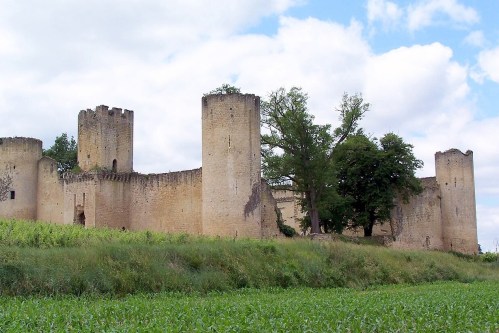
I head my Cannondale northwards and enjoy the sandy, damp paths typical of the Gironde. Suddenly, Château de Budos appears, built during the time of Pope Clement V and inspired by his fortress in Villandraut. The ruins emerge from the vineyards, solid and rough. This castle is managed by ADICHAT on behalf of the Boireau family and is open to visitors. If you are doing the tour in reverse, I recommend stopping here for a wine tasting.
I set off again and change direction. Now I am heading east and from here on I am riding almost parallel to the Garonne. You can’t see it, but it is there and you can hear it. From here on, the landscape begins to open up. The trees thin out, the light changes and vineyards appear along the route. The transition is gentle, almost imperceptible, and the horizon stretches out. I can almost smell the wine in the cellars…
I pass Château de La Salle and continue towards Rayne-Vigneau, cycling easily between the rows of vines. We are in the Sauternes area and it is really pleasant: there are a few small climbs in an almost completely flat region.
A little further on, I see Lafaurie-Peyraguey and, immediately after, Château d’Yquem. It is a castle dating back around 500 years with even older foundations. This manor house is one of the best wineries in the world and has been featured in countless films. It is the only property to have held the title of Premier Cru Supérieur for Bordeaux wines since 1855. Its wine is called the liquid gold of Sauternes.
It is the most beautiful estate I have seen in this area of Nouvelle Aquitaine. It is surrounded by vineyards, on top of a small hill and is very well preserved – it can be visited with wine tasting -.
I set off slowly and the sun came out. With the humidity evaporating, the atmosphere was even more evocative.

A few kilometres later, I arrive at Château Giraud, and immediately afterwards at Château Filhot (17th century). This is where the Raisin d’or begins. The soil, the rhythm, the location, even the light: everything seems to be in the right place. Its vast 350-hectare estate has a park that blends into the natural landscape; its creator, Louis-Bernard Fisher, used meadows, woods and water features to create a freer, more romantic, English-style garden.
Next is Château de Fargues. The temperature drops a little, and the paths become more compact, interrupted only by a few muddy stretches. I start cycling again, and after passing through Roaillan, the towers of Château de Roquetaillade come into view. It was built in 1306 by Cardinal Gaillard de la Mothe, nephew of Pope Clement V, on fortifications dating back to the 12th century. Its current appearance is the result of 19th-century restoration work commissioned by Viollet-le-Duc. The castle is open to visitors, but be sure to check the opening hours.
After a well-deserved break, I put my 4KAAD glasses back on and set off for my final destination: the Collegiate Church of Saint-Jean-Baptiste in Uzeste. This is the resting place of Clement V, the pope who oversaw the suppression of the Knights Templar and the Avignon Papacy.
I lean my Cannondale against the wall and admire this 13th-century Gascon Gothic sacred building commissioned by Bertrand de Got himself.
From here, I take the easy cycle path that leads me to La Maison Adichats in Villandraut. My legs turn, my shoulders relax. When the castle walls appear on the horizon, everything feels familiar, the circle is closing.
Over the past two months, I have climbed to the top of the castle towers several times. From there, you can see the Collegiate Church in the distance and admire a vast landscape rich in history. For visits and to try the escape room, all you have to do is search among the thousands of activities on www.assoadichats.net.
Dear friends of simplyroads.com, that’s all for today. Adishatz!
Tour dei Castelli della Garonna
Bonjour à tous les amis de simplyroads.com!
Oggi vi accompagno in un giro tra i castelli sulla sinistra della Garonna. La nostra partenza e arrivo è sempre il castello papale di Villandraut.
Non è la giornata perfetta per uscire in bici: la temperatura è piuttosto bassa e c’è la bruma. Ma per quest’ultima ho i miei 4KAAD con lenti fotocromatiche gialle, inoltre il clima autunnale mi è sempre piaciuto.
Poche pedalate e il villaggio è già alle mie spalle. Ripercorro alcuni single track lungo il Ciron di cui vi ho già parlato. Uno di questi attraversa un boschetto di bambù. La luce filtra a fatica tra i fusti alti e scuri, tutto è immerso in una penombra profonda ed eterea, come nei film di Zhang Yimou.
Dirigo la mia Cannondale verso nord e mi godo i sentieri sabbiosi e umidi tipici della Gironda. Appare d’improvviso Château de Budos, edificato al tempo di papa Clemente V e ispirato alla sua fortezza di Villandraut. Le rovine emergono dai vigneti, solide e ruvide. Questo è un castello in gestione ad ADICHAT che lo gestisce per conto della famiglia Boireau, è visitabile – se fate il giro inverso consiglio di effettuare qui una degustazione di vini -.
Riparto e cambio direzione. Adesso mi muovo verso est e da ora in poi corro quasi parallelo alla Garonne, non la si vede ma è lì e la si può sentire. Da qui in poi il paesaggio inizia ad aprirsi. Gli alberi si diradano, la luce cambia e i vigneti compaiono lungo il tracciato. La transizione è dolce, quasi impercettibile e l’orizzonte si allunga. Riesco quasi a sentire l’odore del vino nelle cantine…
Passo vicino a Château de La Salle e continuo verso quello di Rayne-Vigneau, pedalando facilmente tra i filari d’uva. Siamo nella zona di Sauternes ed è davvero piacevole: ci sono alcune piccole salite in una regione quasi completamente pianeggiante.
Poco più avanti scorgo Lafaurie-Peyraguey e subito dopo Château d’Yquem. È un castello di circa 500 anni con fondamenta più antiche. Questo maniero è una delle cantine migliori al mondo con innumerevoli citazioni filmiche. È l’unica proprietà a vantare dal 1855 il titolo di Premier Cru Supérieur dei vini di Bordeaux. Il suo vino è chiamato l’oro liquido di Sauternes.
È il più bel podere che abbia visto in questa zona della Nouvelle Aquitaine. È in mezzo ai vigneti, in cima a una piccola collina ed è conservato benissimo – è visitabile con degustazione -.
Riparto piano ed è spuntato il sole, l’atmosfera, con l’umidità che evapora, è ancora più suggestiva.

Pochi chilometri ed eccomi a Château Giraud, e subito dopo a Château Filhot (XVII sec). È da qui che prende il via la Raisin d’or . Il terreno, il ritmo, il luogo, persino la luce: ogni cosa sembra essere al posto giusto. La sua vasta proprietà di 350 ettari ha un parco che si inserisce nel paesaggio naturale; il suo creatore, Louis-Bernard Fisher, ha sfruttato prati, boschi ed elementi acquatici per creare uno stile più libero e romantico, all’inglese.
Il successivo è Château de Fargues. La temperatura scende un po’, e i sentieri si fanno più compatti, interrotti solo da qualche tratto fangoso. Riprendo a pedalare, e dopo aver attraversato Roaillan, ecco spuntare le torri di Château de Roquetaillade. Fu costruito nel 1306 dal cardinale Gaillard de la Mothe, nipote di Papa Clemente V, su fortificazioni che risalgono al XII secolo. L’aspetto attuale è frutto dei restauri del XIX voluti da Viollet-le-Duc. Il castello è visitabile, ma attenzione agli orari.

Dopo una meritata pausa, inforco nuovamente i miei occhiali 4KAAD e sono pronto a raggiungere l’ultima meta: la Collegiale di Saint-Jean-Baptiste a Uzeste. Qui riposa Clemente V, il papa protagonista della soppressione dei Templari e della Cattività avignonese.
Appoggio la mia Cannondale al muro e ammiro questo edificio sacro in stile gotico guascone del XIII secolo voluto dallo stesso Bertrand de Got.
Da qui in poi prendo la comoda pista ciclabile che mi porta a la maison Adichats a Villandraut. Le gambe girano, le spalle si rilassano. Quando le mura del castello appaiono all’orizzonte, tutto è familiare, si sta chiudendo il cerchio.

In questi due mesi sono salito più volte in cima alle torri del castello. Da lì si scorge in lontananza anche la Collegiale e si può ammirare una ampio paesaggio ricco di storie. Per le visite e per provare l’escape room non vi resta che cercare fra le mille attività di https://www.assoadichats.net .
Cari amici di simplyroads.com per oggi è tutto. Adishatz!
 Akira06 Bike AdvenTour
Lascia un commento